GeoDiT-Ω: Unified Spatial Control
for Satellite Image Synthesis with Any
Geospatial Primitive

ECCV 2026
Washington University in St. Louis
*Equal contribution
Paper Coming Soon arXiv Coming Soon Code Weights Coming Soon
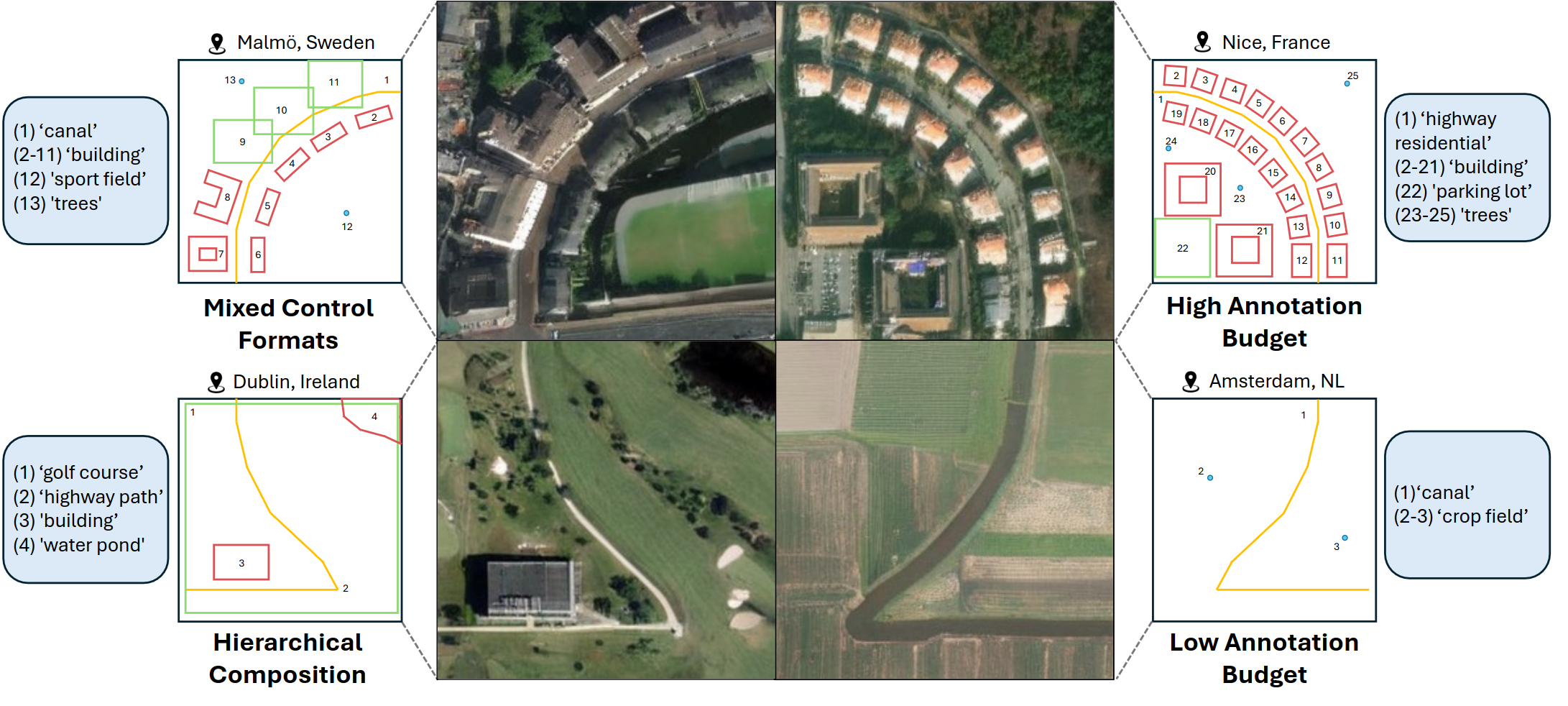
GeoDiT-Omega teaser figure

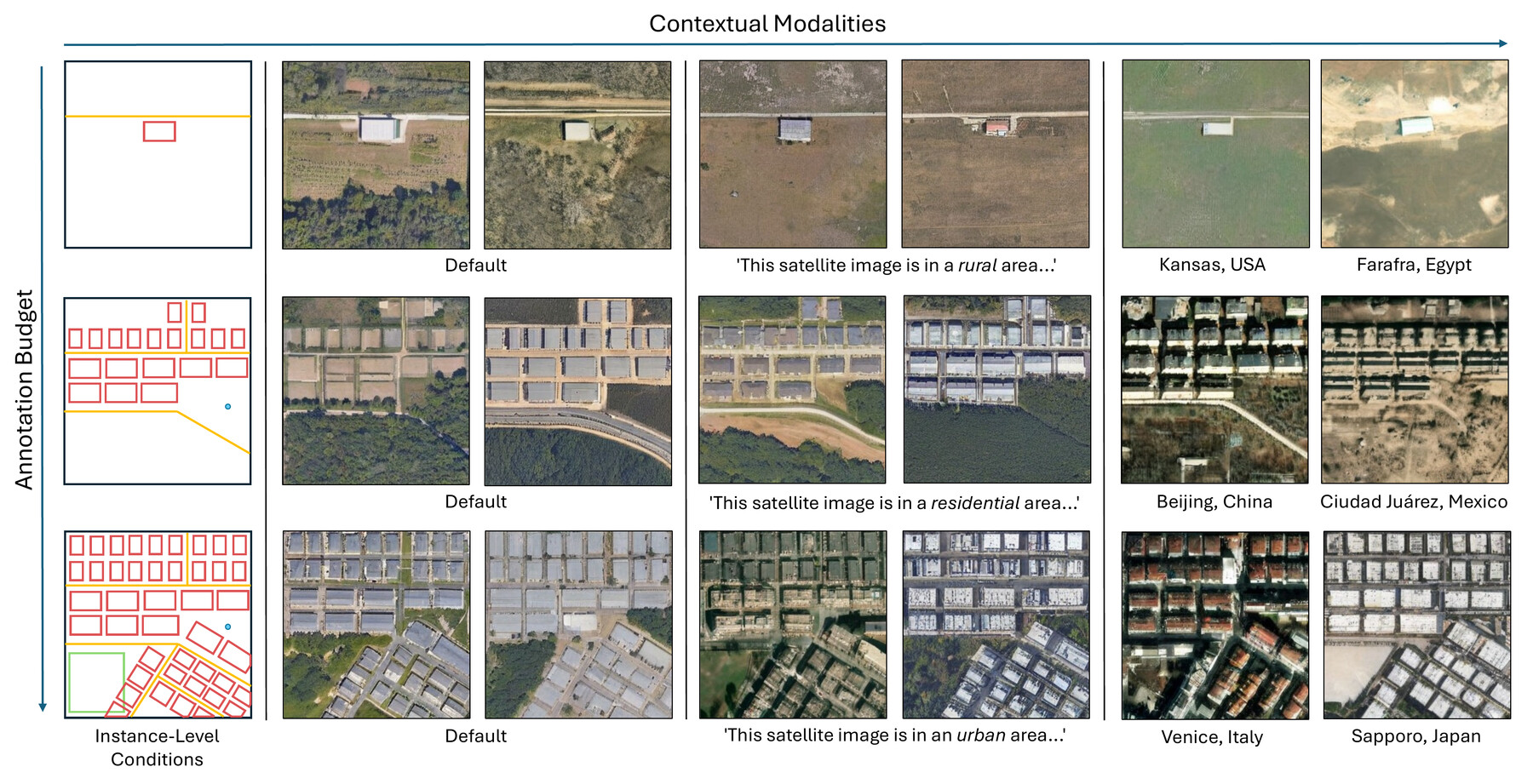
GeoDiT-Ω enables precise synthesis using polygons, polylines, bounding boxes, points, along with text and geolocation conditioning. This unified framework supports hierarchical composition and adapts to both high and low annotation budgets.

Abstract

TL;DR — GeoDiT-Ω is a single diffusion model that generates satellite imagery directly from any geospatial primitive (polygons, polylines, boxes, or points), replacing task-specific pipelines with one model that boosts downstream segmentation, detection, road extraction, and classification.

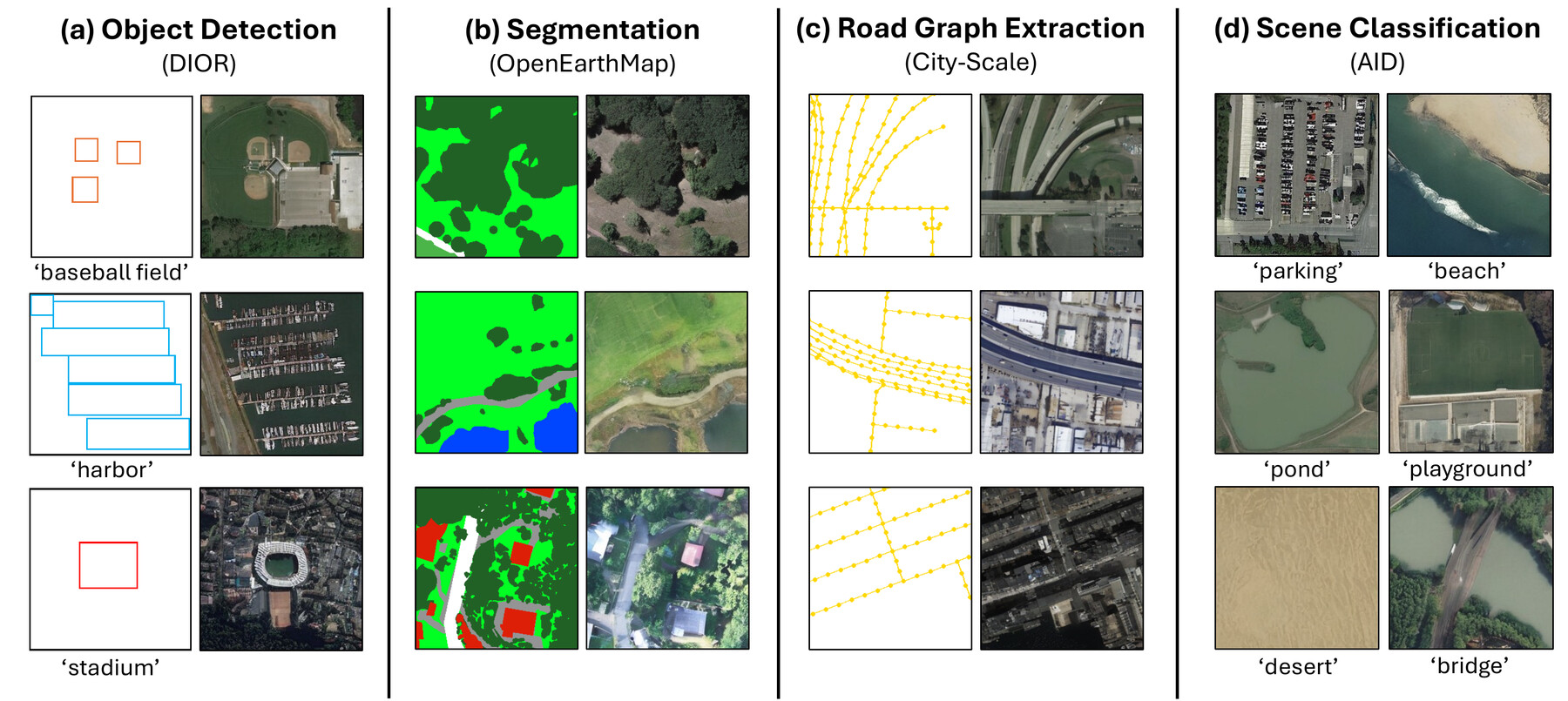
Generative models have achieved remarkable progress, yet applying them to satellite imagery remains challenging. Unlike natural imagery, satellite scenes are structured by spatially complex and semantically distinct geometries. Prior work addresses this complexity by adapting natural image frameworks using dense rasters or sparse prompts, trading off annotation cost and fidelity while breaking compatibility with vector primitives commonly used to represent geographic information. We introduce GeoDiT-Ω, a unified spatial control framework that generates satellite imagery directly from any native geospatial primitive. By jointly leveraging precise annotations (polygons, polylines) and coarser ones (bounding boxes, points), the model supports controllable layouts across varying annotation budgets, broadening applicability to design tasks such as urban planning while remaining naturally compatible with end-to-end GeoAI workflows. To effectively leverage these primitives during generation, we propose Geometry-Aware Local Attention, a conditioning mechanism that injects explicit geometric cues into the attention space. Across all conditioning formats, our approach consistently outperforms both dense-control and sparse-control baselines. Furthermore, the flexibility of using primitives enables controllable synthetic data augmentation for multiple remote sensing tasks where labeled scenes are costly to acquire. Using a single generative model rather than task-specific pipelines, we improve performance on land-cover segmentation, object detection, road graph extraction, and scene classification.

Method

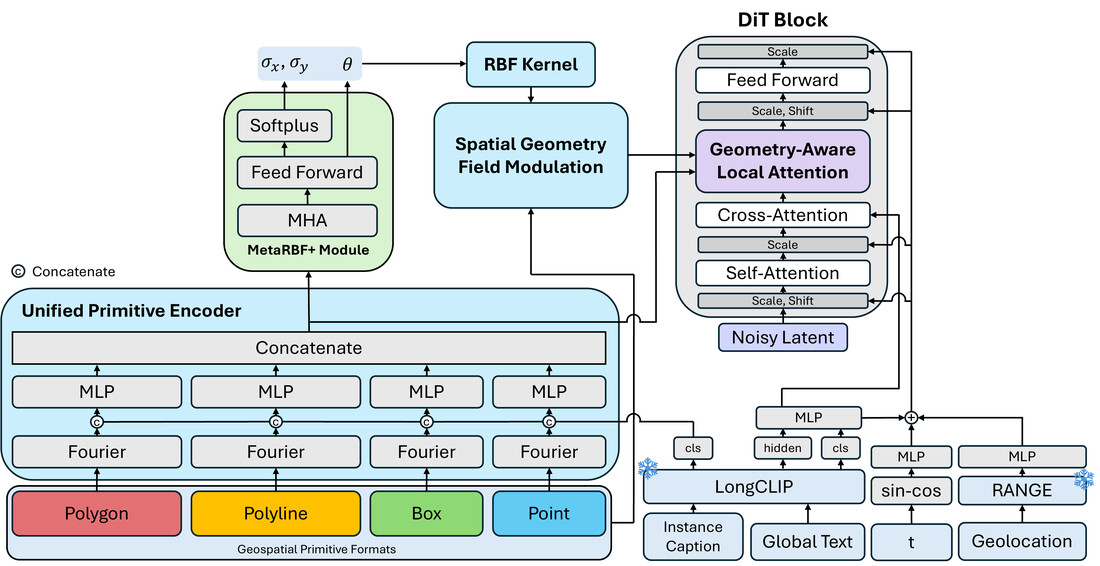
GeoDiT-Omega unified primitive encoder

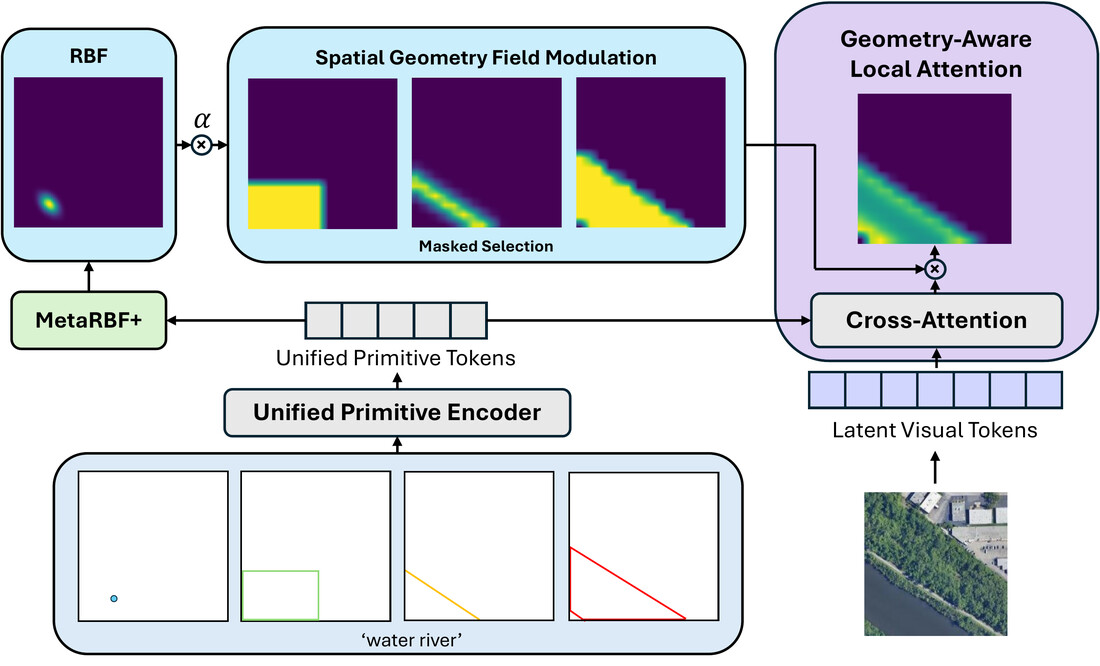
Overview of GeoDiT-Ω architecture.

Geometry-Aware Local Attention (GALA)

Geometry Aware Local Attention.

1

Encoding

Each scene instance can be described by any primitive format—polygon, polyline, box, or point. A Unified Primitive Encoder turns each into a shared token: geometry is Fourier-encoded and passed through an MLP, with the instance's text caption concatenated in. Global text and geolocation context are added separately—captions via LongCLIP, geolocation via RANGE.

2

Conditioning (GALA)

Unified primitive tokens condition generation through Geometry-Aware Local Attention (GALA): each token cross-attends to the diffusion transformer's visual tokens, then is modulated by a learned RBF field (MetaRBF+) and a spatial geometry field—together injecting a spatial inductive bias that adapts to each primitive's geometry. Global text conditions the model via standard cross-attention; geolocation and timestep via adaptive layer norm.

3

Generation

The conditioned tokens drive a standard diffusion transformer denoising process to produce the final satellite image.

BibTeX

@inproceedings{wei2026geoditomega,
  title     = {GeoDiT-Ω: Unified Spatial Control for Satellite Image
               Synthesis with Any Geospatial Primitive},
  author    = {Wei, Brian and Sastry, Srikumar and Cher, Daniel and Xing, Eric and Jacobs, Nathan},
  booktitle = {European Conference on Computer Vision},
  year      = {2026}
}